Colour-Matched Finishes
Timber Pro stains in a range of colours, or custom-matched to your cottage or boathouse siding.
Every Inclined Elevation lift is engineered for the Canadian Shield—steep granite, cold winters, and demanding shorelines. Below the surface of a graceful ride sits decades of refined mechanical thinking.
Every component of an Inclined Elevation lift has been thought out, designed, and tested for safety and stability.
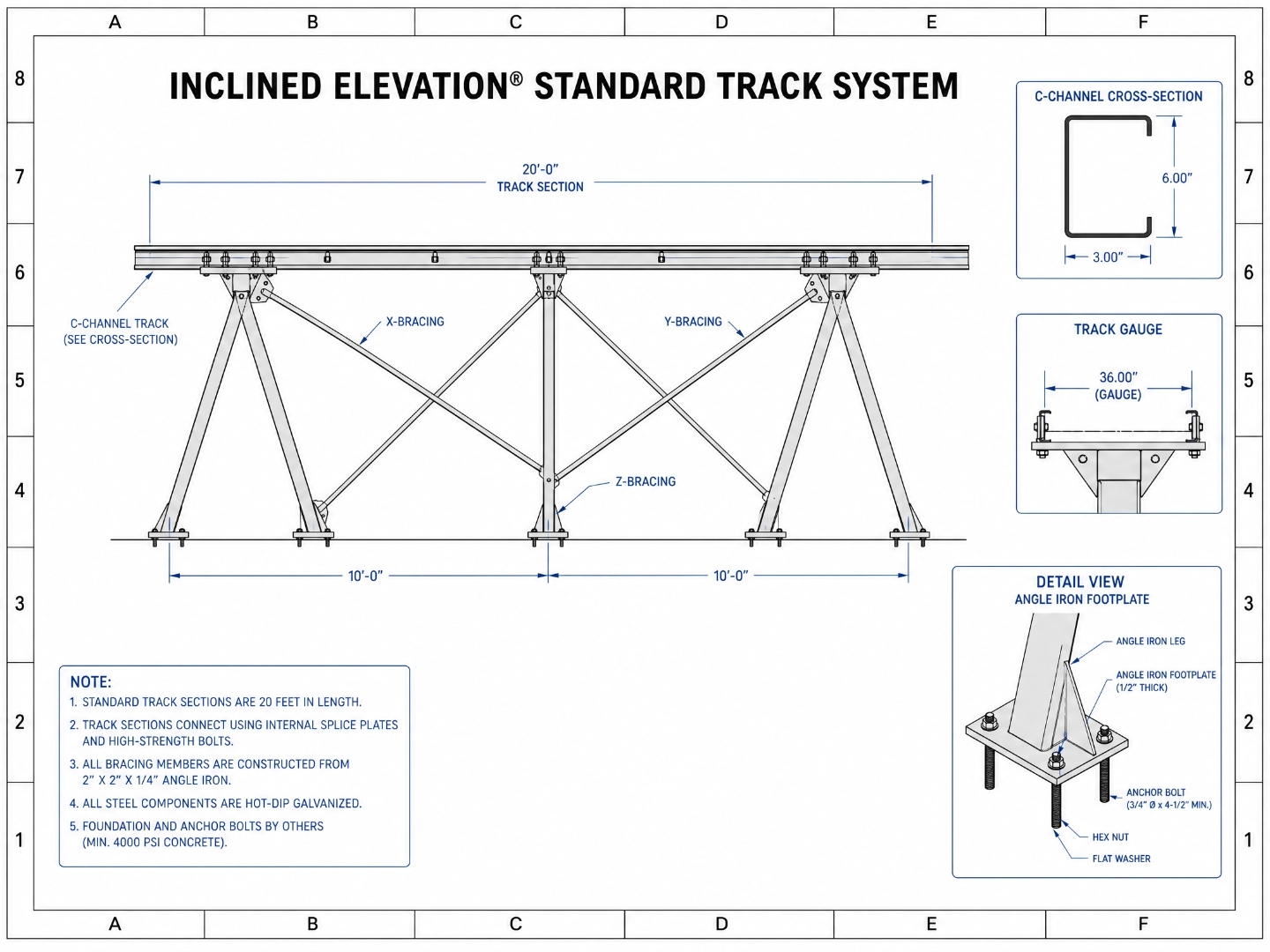
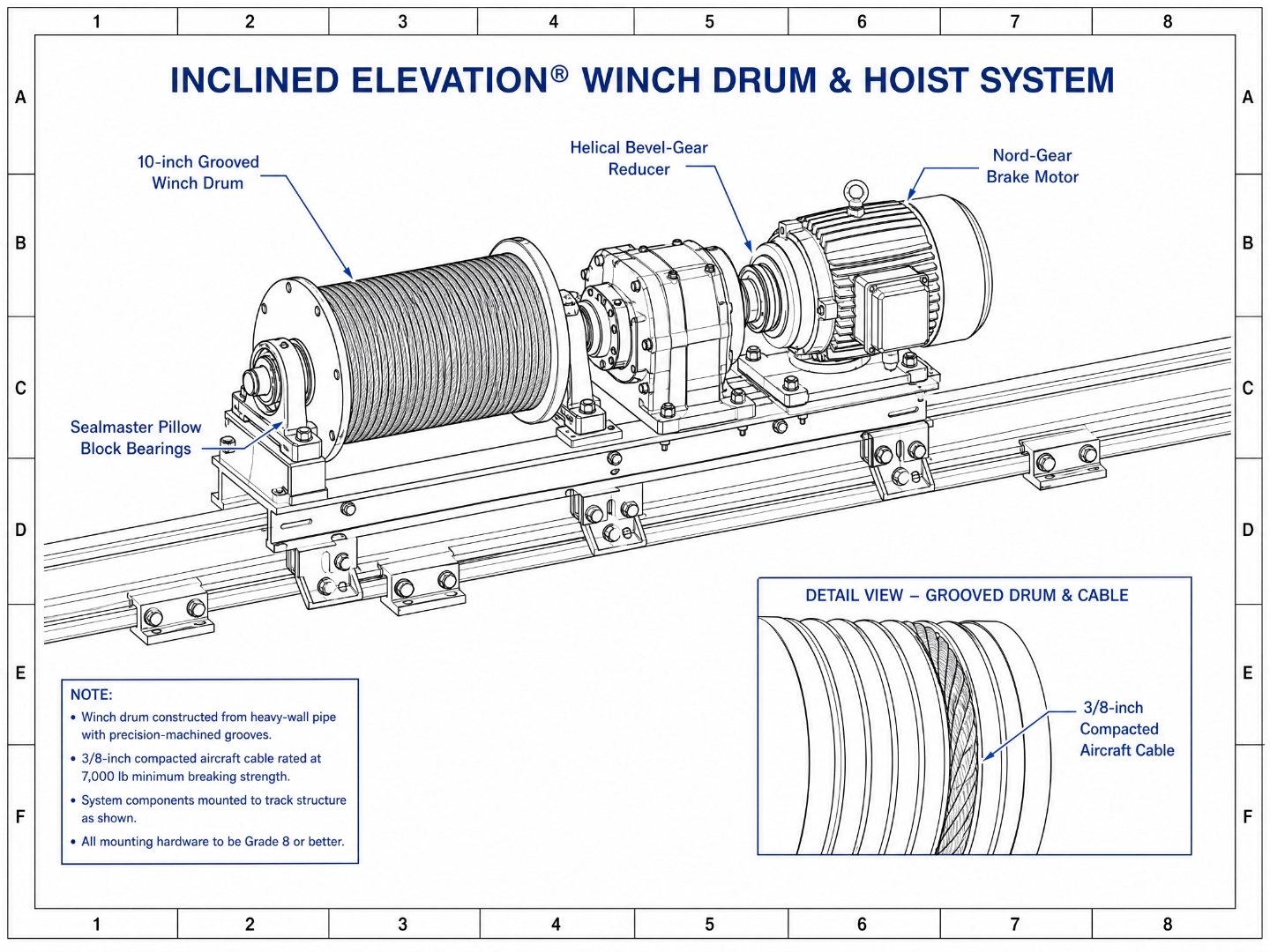
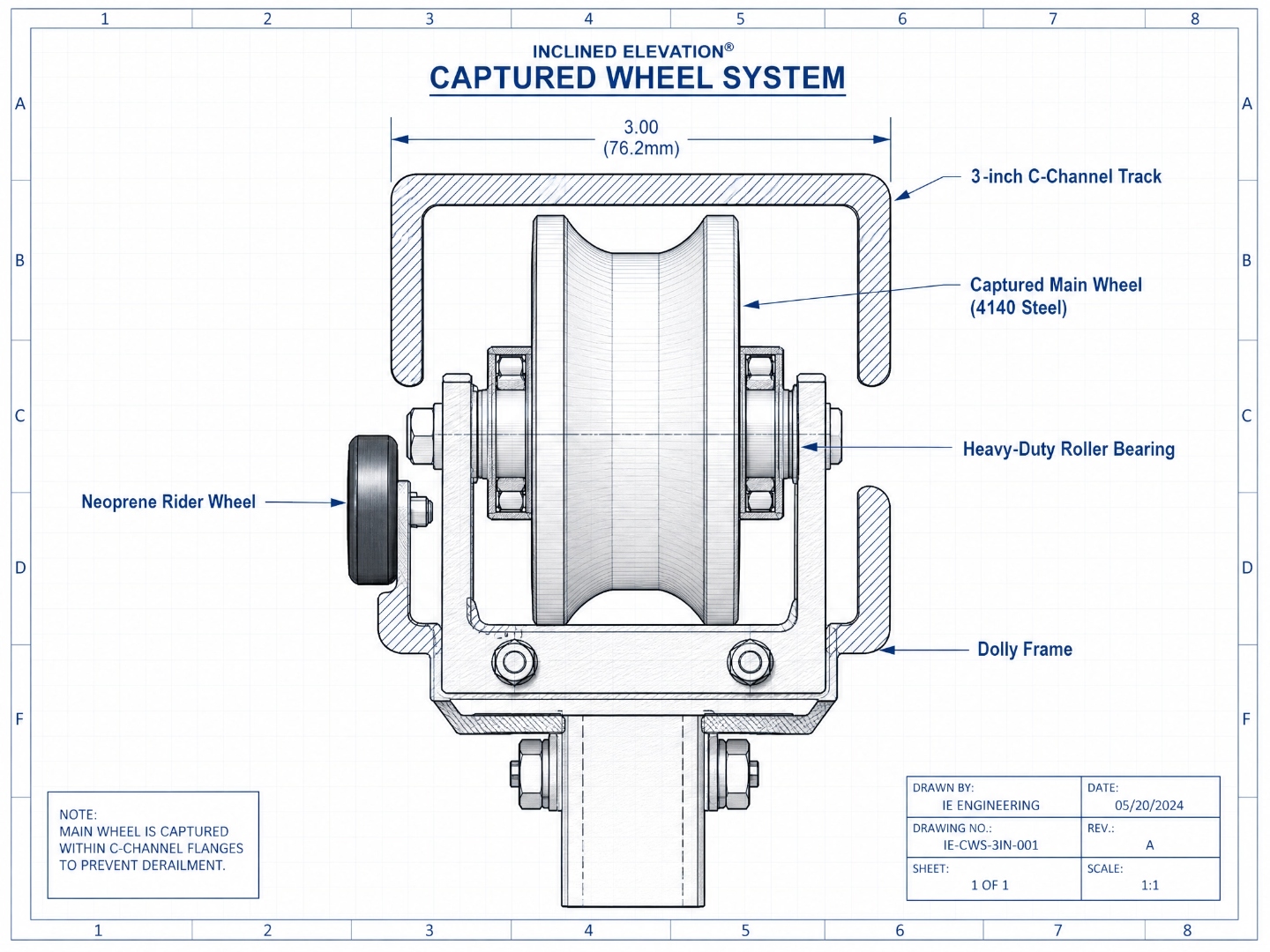
These diagrams are illustrative only. They approximate the equipment and are not exact renderings.
A German-engineered elevator overspeed governor anchors a triple-redundant braking system. Should the car exceed 0.5 m/s, flame-hardened 4140 steel brake dogs drive into the track and the car stops within a fraction of an inch.
Industrial-duty, 3-phase Nord-Gear brake-motors run through a variable-frequency drive on standard 220 V input. The car accelerates smoothly to 75 feet per minute, then decelerates to a gentle stop.
The dolly rides on four custom-machined 4140 tool steel wheels pressed onto heavy-duty industrial roller bearings. Wheels run INSIDE the C-channel track—derailing through ice, snow or thermal shift is mechanically impossible.
Six reasons why every Inclined Elevation lift provides the best ride you can buy.
Concrete piers must sit below the frost line, or they heave. On a 45° slope with a 48" frost line, that pier hole would need to be 67" deep—and on cracked, fissured Canadian Shield rock the true frost line is often impossible to predict. Instead, we anchor track legs directly into bedrock with sealing cement and anchor bolts where possible. On forest floor, we trench out organic material, fill with pea gravel for drainage, set a 3"×2"×¼" angle iron footplate, and pin it with rebar stakes. Each track leg carries less than 1,500 lbs under a fully loaded car, and the triangular support geometry eliminates torque on the footings—so footings stay light, low-impact, and stable.
Some shorelines drop in two distinct grades—a flatter upper section, then a steeper cliff. A standard single-pitch lift cannot keep the car level across the break. In 2011, we developed our own two-pitch track and car system. The track uses three sections—upper, a circular-arc curved section, and lower—while a second “pipe track” runs parallel and displaced uphill. Above the curve, an oversized chain holds the car level. In and below the curve, the car is connected to the dolly with an oversized hinge, and “back-riggers” with rollers that ride beneath the pipe track to keep the car perfectly level the entire run.
Our captured-wheel system makes derailing through ice or snow accumulation mechanically impossible. Optional ice scrapers clear the top of the track during winter use. Industrial-duty motors and synthetic-lubricated Nord-Gear reducers operate reliably through Canadian winter extremes.
Three independent systems protect the car: (1) A slack-cable brake—if the cable goes slack by less than an inch, both gravity and a coil spring drive 4140 steel brake dogs into the track, stopping the car within a fraction of an inch. (2) An over-speed brake driven by a German elevator overspeed governor fires above 0.5 m/s. (3) A slack-cable motor shut-off kills the hoist motor the instant the cable loses tension. Should a brake trip occur for any reason, the car can still be safely raised to the upper station. Riders never get stranded.
All passenger lifts run on 3/8" compacted aircraft cable with a breaking strength over 15,600 lbs. (Actual operating loads are typically under 1,000 lbs.) Grooved 10" winch drums machined at Bracebridge Machine Shop from heavy-wall pipe provide a smoother ride and extend the life of the cable. (Most competitors use 6" drums.) The hoist cable attaches to the top end of the dolly, placing the lifting point above the car’s centre of gravity so the car is inherently stable.
Each lift runs on a Programmable Logic Controller (PLC) executing our proprietary lift control system programs. It reads user buttons, track-mounted proximity switches, and station gate limit switches. It controls the motor through the VFD and operates automatic station gates. Optional features include auto-shutoff after inactivity (minutes to days to never), a PARK button that returns the car to a chosen station, wireless remote operation from car or boat, and integrated control of dock and garden lighting.
Many inclined lifts on Canadian shorelines are built to a similar baseline. The Inclined Elevation lift is built to a higher standard. Here is how the two compare, component by component.
| Component | Inclined Elevation | Standard Industry Practice |
|---|---|---|
| Track Guide System | Captured-wheel design. Custom-machined 4140 tool-steel wheels run inside the C-channel track on heavy-duty industrial roller bearings. Cannot derail in ice or snow. | Wheels ride on top of the rails. Vulnerable to derailing under ice, debris or thermal shift. |
| Track Support Spacing | Legs every 10 ft (shallow track) or every 20 ft (standard track), with all-welded triangular geometry that eliminates torque on footings. | Wider, less frequent supports; rectangular leg geometry that loads footings under torque. |
| Footing Strategy | Anchored to bedrock with sealing cement and anchor bolts; on forest floor, pinned angle-iron footplates over pea-gravel drainage. Frost-resilient by design. | Concrete piers that must reach below frost line—impractical or impossible on cracked granite, and prone to heaving. |
| Track Geometry Capability | Single-pitch, 2-pitch, and 3-pitch tracks (proprietary, developed in 2011). The only Canadian builder of multi-pitch lifts. | Single-pitch only. Complex shorelines either re-engineered (at the owner’s cost) or refused outright. |
| Track Alignment Tolerance | ± 1/16 in. at every leg, set with track-mounted transit before welding. | “Eyeballed” or shimmed to the raw stock—leading to ride harmonics and uneven cable wear. |
| Hoist Motor | Industrial-duty, 3-phase, variable-speed Nord-Gear brake-motor with VFD control. Smooth acceleration to ~75 ft/min and a gentle stop. | Single-speed AC motor. Lurching starts, abrupt stops, and constant cable shock. |
| Winch Drum | 10-inch grooved drum machined from heavy-wall pipe at Bracebridge Machine Shop. Longer cable life, quieter ride. | 6-inch drum—faster cable fatigue, more vibration, more maintenance. |
| Hoist Cable | 3/8 in. compacted aircraft cable, North-American manufactured, 15,600 lb breaking strength (10 mm option: 22,000 lb). Swaged wedge anchors at the dolly. | Offshore non-compacted cable, lower breaking strength, friction wedge anchors. |
| Hoisting Geometry | Cable attached to the top of the dolly—lifting point sits above the centre of gravity. Inherently stable. | Cable attached at the bottom of the dolly (industry default)—inherently unstable under sway or sudden load. |
| Emergency Braking | Three independent systems: slack-cable brake, over-speed brake with precision-engineered German governor, and slack-cable motor shut-off. Brake dogs are flame-hardened 4140 steel. | Single brake system, typically cable-actuated, with no over-speed governor. |
| Over-Speed Governor | German-engineered. Tripping speed decreases as the governor stiffens with age—fails safe. | Conventional governor. Tripping speed increases as pivots stiffen—fails unsafe. |
| Lift Control System | Programmable Logic Controller (PLC) running our proprietary Lift Control System. Reads track proximity switches, station-gate limits, and user inputs. Wireless remote included. | Relay-logic control box or basic up/down contactor. No remote, no station-gate interlocks. |
| Country of Build | Fabricated and assembled in Bracebridge, Ontario. Specialty components (German brake governors) integrated where they outperform domestic alternatives. | Assembled offshore or imported as a kit; service parts dependent on overseas supply. |
| Warranty | 5-year structural / 2-year mechanical. Every original Inclined Elevation lift—20 years and 150+ installs—is still in operation. | 1-year limited warranty typical; replacement parts often discontinued within a decade. |
This comparison reflects general industry practice based on 20+ years of servicing other builders’ installs and is not directed at any single competitor. Specifications for individual lifts vary with site conditions.
Nothing is off-the-shelf with an Inclined Elevation lift. Your cottage is an architectural statement. Your lift should be an appealing extension.
Timber Pro stains in a range of colours, or custom-matched to your cottage or boathouse siding.
Red cedar seats, floors, walls and top rails fastened with rust-proof brass screws and blind nuts.
Machinery covers and car detailing designed to mirror the specific timber framing of your home.
Custom-named stations: “The Boathouse.” “The Upper Ridge.” Even name the lift itself.